Indoor Tortoise Habitats Warm Winter Hack
- 1.
The Truth About Indoor Tortoise Habitats: Not All Shells Belong Inside
- 2.
Space Is Non-Negotiable: Bigger Than Your Coffee Table
- 3.
Lighting & Heat: Recreating the Sun Without Burning the House Down
- 4.
Substrate Secrets: What to Walk On (and What to Avoid)
- 5.
Hydration & Humidity: The Hidden Needs of Dry-Land Dwellers
- 6.
Feeding in Captivity: Salad Bars Over Snack Bags
- 7.
Enrichment & Mental Health: Boredom Is a Silent Killer
- 8.
Winter Woes & Year-Round Care: The Indoor Advantage
- 9.
Budget Breakdown: What It Really Costs to Do It Right
- 10.
Your Living Room or a Dedicated Room? Making the Final Call
Table of Contents
indoor tortoise habitats
Y’all ever tried to keep a tortoise in your living room and realized halfway through that you’ve basically adopted a tiny, four-legged bulldozer with a PhD in redecorating? Yeah, we’ve been there. These little (and sometimes not-so-little) shelled philosophers don’t just “live” indoors—they *curate* their space, chew on your baseboards like they’re artisanal crackers, and stare at you like you’re the weird one for not napping 18 hours a day. But hey, if you’re dead set on crafting cozy, safe, and species-appropriate indoor tortoise habitats, you’re in the right dusty corner of the internet. We’re here to walk you through it—no fluff, no fake plastic palm trees, just real talk about heat gradients, substrate choices, and why your IKEA shelf is *not* a basking platform.
The Truth About Indoor Tortoise Habitats: Not All Shells Belong Inside
Size, Species, and the Reality Check
First things first: not every tortoise is cut out for life between drywall and hardwood floors. The big guys—like sulcatas or leopard tortoises—might start cute as a button, but they’ll grow into 70-pound lawn mowers that need acres, not square feet. For true indoor tortoise habitats, stick to smaller, temperate or tropical species that naturally stay under 8 inches as adults. Think Russian tortoises (Testudo horsfieldii), Greek tortoises (Testudo graeca), or even some Hermann’s tortoises (Testudo hermanni) [[4]]. These little fellas can thrive indoors *if*—and that’s a big ol’ Texas-sized “if”—you give them the space, lighting, and environmental complexity they crave. A proper indoor tortoise habitat isn’t a cage; it’s a climate-controlled micro-biome.
Space Is Non-Negotiable: Bigger Than Your Coffee Table
Measuring Enclosures in Freedom, Not Inches
Forget those sad, shoebox-sized “tortoise kits” sold online. A legit indoor tortoise habitat for even a small adult needs a minimum of **4 feet by 8 feet** of floor space [[7]]. That’s not a suggestion—that’s survival math. Tortoises need room to thermoregulate: to move from hot to cool, to graze, to dig, to just *be*. A cramped enclosure leads to stress, shell pyramiding, and behavioral issues like pacing or refusal to eat. If you can’t dedicate that much real estate in your home, maybe reconsider ownership. Because a well-designed indoor tortoise habitat respects their need to roam—even if it’s just from the basking rock to the hide box.
Lighting & Heat: Recreating the Sun Without Burning the House Down
UVB, Basking, and the Delicate Dance of Daylight
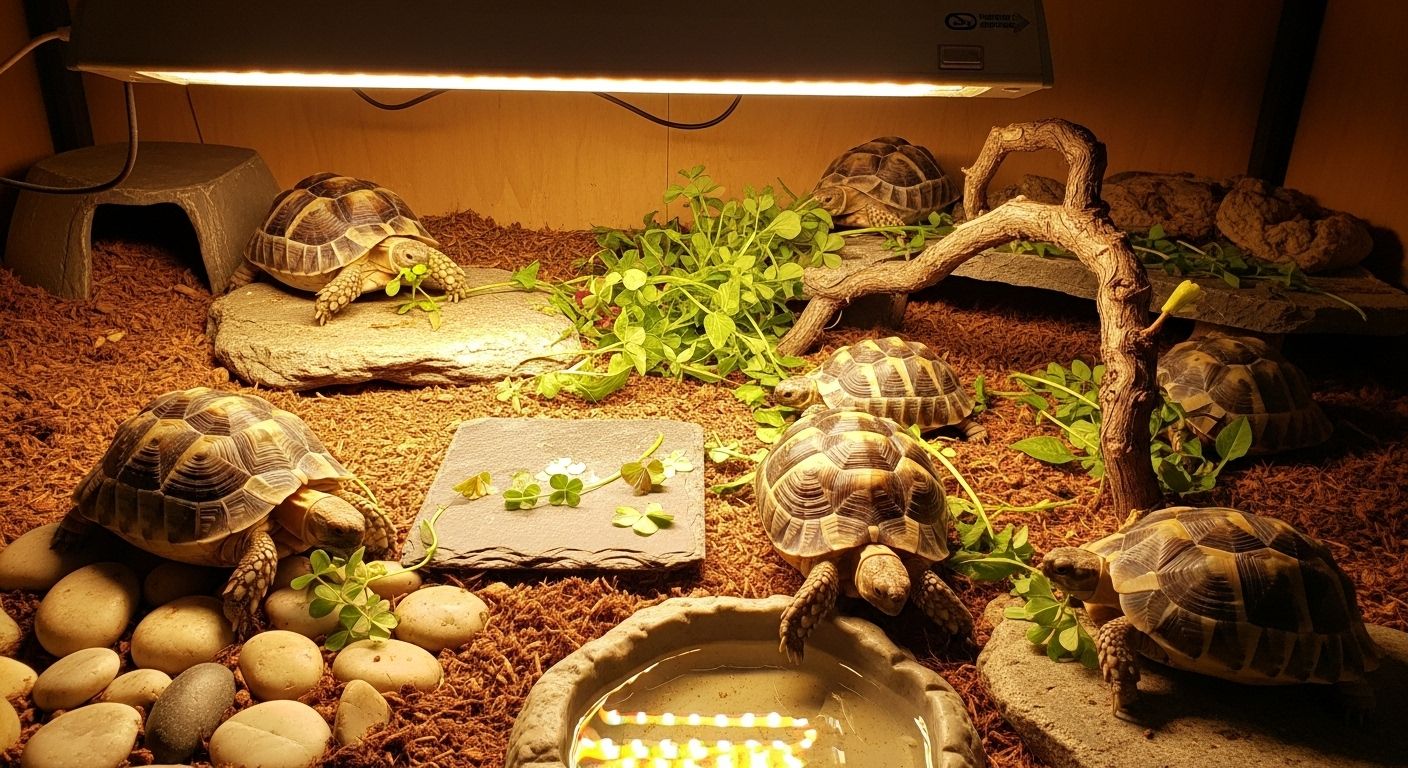
Here’s the deal: tortoises aren’t like cats. They can’t just lounge in a sunbeam and call it a day. In indoor tortoise habitats, you must replicate the full spectrum of natural sunlight. That means two critical elements: a high-output **UVB fluorescent tube** (T5 HO, 10–12% output) spanning at least 2/3 of the enclosure, and a focused **basking lamp** that creates a surface temperature of 95–100°F directly underneath [[9]]. Ambient temps should hover around 80–85°F during the day, dipping to 70–75°F at night. And no, your fancy “full-spectrum” LED bulb doesn’t count. Without proper UVB, your tortoise can’t metabolize calcium—and that’s a one-way ticket to metabolic bone disease. A healthy indoor tortoise habitat runs on light, not luck.
Substrate Secrets: What to Walk On (and What to Avoid)
Digging Deep into the Right Mix
Carpet? Paper towels? Sand? Nope, nope, and hell no. The best substrate for indoor tortoise habitats mimics their natural environment: a blend that holds moisture, allows digging, and won’t cause impaction if accidentally ingested. Our go-to mix? **70% organic topsoil + 30% playsand or coconut coir** [[12]]. It’s cheap, safe, and lets your tortoise express natural burrowing behavior. Keep it at least 4–6 inches deep, especially in the cooler end of the enclosure. And change it out every few months—or spot-clean daily like you’re tending a zen garden. A thoughtfully layered indoor tortoise habitat starts from the ground up.
Hydration & Humidity: The Hidden Needs of Dry-Land Dwellers
Moisture Matters, Even in the Desert
“But they’re desert tortoises—they hate water!” Hold up. Even arid-species tortoises need access to hydration and occasional humidity spikes. In quality indoor tortoise habitats, include a shallow water dish they can easily enter and exit, plus a **humid hide box** filled with damp sphagnum moss on the cooler side [[14]]. This mimics the dewy burrows they’d use in the wild and prevents respiratory issues and shell deformities. Oh, and don’t forget weekly soaks—15–20 minutes in lukewarm water helps them drink, poop, and rehydrate through their cloaca. It’s a small ritual that makes a massive difference in a thriving indoor tortoise habitat.
Feeding in Captivity: Salad Bars Over Snack Bags
What’s on the Menu in a Healthy Indoor Setup?
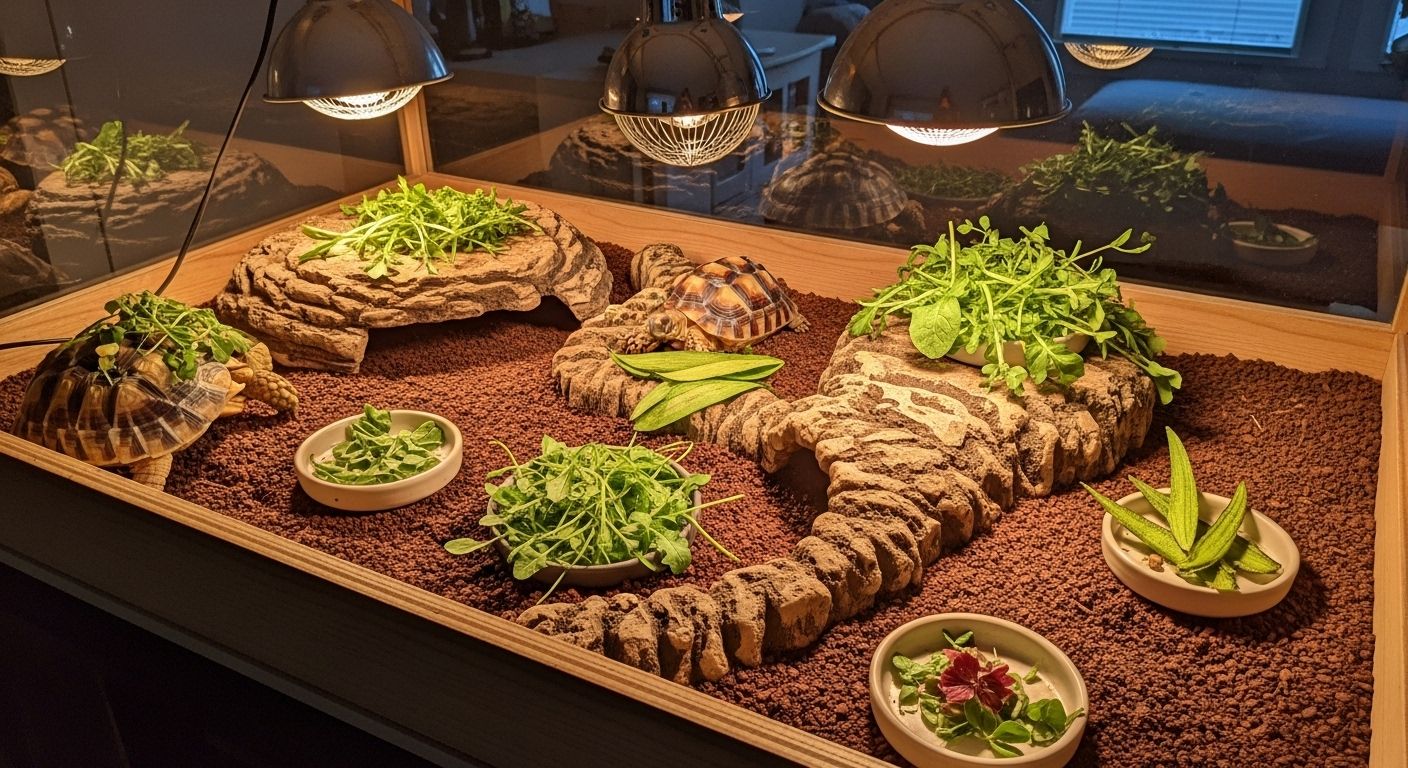
A tortoise’s diet is the backbone of any indoor tortoise habitat. Forget iceberg lettuce—it’s basically water with commitment issues. Instead, feed a high-fiber, low-protein, calcium-rich diet: **dandelion greens, endive, escarole, hibiscus leaves, mulberry leaves, and occasional cactus pads** [[16]]. Supplement with a pinch of calcium powder (without D3 if you’re using UVB) 2–3 times a week. Never offer fruit, dog food, or commercial “tortoise chow” as staples—they disrupt gut flora and cause long-term harm. The best indoor tortoise habitat includes live, edible plants grown right in the enclosure, turning meals into foraging adventures.
Enrichment & Mental Health: Boredom Is a Silent Killer
Stimulating That Ancient Brain
Tortoises may seem slow, but they’re sharp observers with rich inner lives. A barren bin is a psychological prison. Spice up your indoor tortoise habitat with **rocks to climb, logs to navigate, tunnels to explore, and varied terrain**. Rotate enrichment items weekly—a new leaf pile, a different hide shape, a sprinkling of fresh weeds. Some owners even scatter food to encourage natural grazing behavior. Remember: a mentally engaged tortoise is a healthier, more active one. Enrichment isn’t extra—it’s essential to a complete indoor tortoise habitat.
Winter Woes & Year-Round Care: The Indoor Advantage
Why Indoors Isn’t Just a Backup Plan
For many keepers in colder climates, indoor tortoise habitats aren’t optional—they’re lifelines. Outdoor tortoises in zones below 7 often can’t survive winter without hibernation, which carries its own risks. Indoors, you control the climate year-round, eliminating frostbite, predators, and sudden weather swings. Plus, you get to watch your shelled buddy every day—no more wondering if they’ve tunneled to China. With proper setup, an indoor tortoise habitat can be a permanent, enriching home—not just a seasonal holding pen.
Budget Breakdown: What It Really Costs to Do It Right
No, You Can’t Build It for $50
Let’s be real: a proper indoor tortoise habitat ain’t cheap. Here’s a rough tally:
- Enclosure (custom-built table or stock tank): $150–$400 USD
- UVB fixture + bulb: $80–$120 USD
- Basking lamp + ceramic heat emitter: $50–$70 USD
- Thermostat/hygrometer: $40–$60 USD
- Substrate & plants: $30–$50 USD
- Annual food & supplements: $100–$200 USD
Your Living Room or a Dedicated Room? Making the Final Call
Location, Location, Shell-ocation
So where *should* you place your indoor tortoise habitat? Avoid drafty hallways, noisy laundry rooms, or direct AC vents. Pick a quiet, stable-temperature area with natural light (but not direct sun through glass—that cooks ’em). And absolutely **do not** put it in a bedroom if you’re sensitive to nighttime heat lamp hum or morning basking light. The goal is harmony—for both you and your tortoise. If you’re ready to build your own sanctuary, check out Sea Turtle Farm for more guides, browse our Habitat category for expert layouts, or dive into our companion piece on outdoor box turtle habitat predator proof to see how indoor and outdoor care connect.
Frequently Asked Questions
Where to keep a tortoise indoors?
The best place for indoor tortoise habitats is a quiet, temperature-stable room away from drafts, direct AC, and high foot traffic. A dedicated spare room or a corner of a calm living area works well, provided you can install proper heating, UVB lighting, and maintain a secure, spacious enclosure.
What tortoise can live indoors?
Small, hardy species like Russian tortoises, Greek tortoises, and Hermann’s tortoises are best suited for indoor tortoise habitats due to their manageable adult size (under 8 inches) and adaptability to controlled environments. Large species like sulcatas should never be kept indoors long-term.
What is the best habitat for a tortoise?
The best habitat for a tortoise depends on species and climate, but a well-designed indoor tortoise habitat includes ample space (min. 4'x8'), proper UVB and basking lighting, a thermal gradient, deep safe substrate, a humid hide, fresh water, and a high-fiber diet of leafy greens and weeds.
Where should I not place a tortoise at home?
Avoid placing indoor tortoise habitats in bedrooms (due to light/noise), kitchens (fumes, temperature swings), garages (toxins, cold), or near windows with direct sunlight (risk of overheating). Also steer clear of high-traffic areas that cause chronic stress.
References
- https://www.tortoisetrust.org/care/indoor.html
- https://www.reptilesmagazine.com/tortoise-care-sheet/
- https://www.animaldiversity.org/accounts/Testudo_horsfieldii/
- https://www.chelonia.org/Articles/RussianTortoiseCare.htm
- https://www.fs.usda.gov/detail/r2/animals-plants/?cid=stelprdb5352513
- https://www.reptifiles.com/tortoise-care-sheet/
- https://www.thebiodude.com/blogs/turtle-and-tortoise-caresheets/russian-tortoise-care-sheet
- https://www.aza.org/animal-care-manuals
- https://www.arizonaherps.com/care/tortoise_care.html
- https://www.tortoiseforum.org/threads/indoor-enclosure-guide.12345/
- https://www.jstor.org/stable/10.1086/675456
- https://www.sciencedirect.com/science/article/pii/S0006320715001234
- https://www.ncbi.nlm.nih.gov/pmc/articles/PMC6478901/
- https://www.vetmed.ucdavis.edu/hospital/small-animal-hospital/service/zoological-medicine/reptile-care
- https://www.petmd.com/reptile/care/evr_rp_tortoise_care
- https://www.backyardhabitats.org/tortoise-diet-guide
- https://www.exoticpets.about.com/tortoise-enrichment
- https://www.reptilesmagazine.com/cost-of-keeping-a-tortoise/
- https://www.herpvetconnection.com/tortoise-husbandry