Sea Turtle Eggs Hatching Race to Ocean Waves
- 1.
Timing Is Everything: When Do Nature’s Tiny Swimmers Emerge?
- 2.
The Incubation Countdown: How Long Before They Break Free?
- 3.
Don’t Touch That Hatchling—Seriously, Just Don’t
- 4.
The Midnight Crawl: Why Darkness Is Their Best Friend
- 5.
Nest to Ocean: The First 30 Minutes That Define a Lifetime
- 6.
Common Myths About Sea Turtle Eggs Hatchings—Busted
- 7.
How Conservationists Protect Sea Turtle Eggs Hatchings
- 8.
What You Can Do (Without Steppin’ on a Single Egg)
- 9.
From Egg to Open Ocean: What Happens After the Dash?
Table of Contents
sea turtle eggs hatchings
Timing Is Everything: When Do Nature’s Tiny Swimmers Emerge?
Ever waited up all night for pizza delivery only to find out it’s still “on the way”? Yeah, try waitin’ 45 to 70 days for a bunch o’ eggs buried in sand to crack open. Spoiler: those little miracles inside are worth every second. The magic o’ sea turtle eggs hatchings doesn’t run on human clocks—it dances with moon phases, tides, and temperature. Most hatchlings pop out between June and October in the Northern Hemisphere, though Florida beaches might see ‘em as early as May, while Costa Rica keeps the party goin’ through December. The real kicker? They usually emerge at night, under cover o’ darkness, to dodge predators and scorchin’ sun. So if you’re dreamin’ o’ witnessin’ sea turtle eggs hatchings in person, pack your patience—and maybe a thermos o’ coffee.
The Incubation Countdown: How Long Before They Break Free?
“How long does it take for sea turtle eggs to hatch?”—the question we get more than “Where’s the nearest beach bar?” The answer? Roughly 45 to 70 days, dependin’ on the species and sand temperature. Loggerheads? Around 60 days. Leatherbacks? Closer to 70. And here’s a fun fact: warmer sand = faster development… but also more females. Yep, sea turtle sex is decided by how toasty the nest gets. Climate change messin’ with ratios? You bet. But back to the main show: during those weeks, tiny hearts beat beneath the dunes, and flippers practice their first strokes in egg fluid. That’s the quiet miracle o’ sea turtle eggs hatchings—a whole generation waitin’ in the dark for their cue from the moon.
Don’t Touch That Hatchling—Seriously, Just Don’t
Look, we get it. You see a palm-sized turtle wobblin’ toward the surf, heart melts, and your hand twitches like it’s got a mind o’ its own. But resist, y’all. Why can’t we touch baby sea turtles? ‘Cause your scent masks theirs, confusing predators and even their own instincts. Oils from your skin can clog their pores. And that “helpful” nudge toward the water? It robs ‘em o’ the muscle memory they build diggin’ out and crawlin’—which is crucial for imprintin’ the beach’s magnetic signature. So those sea turtle eggs hatchings you’re admirin’? Let ‘em do their thing. Your best move? Stand back, stay quiet, and maybe whisper, “Go get ‘em, lil’ champ.”
The Midnight Crawl: Why Darkness Is Their Best Friend
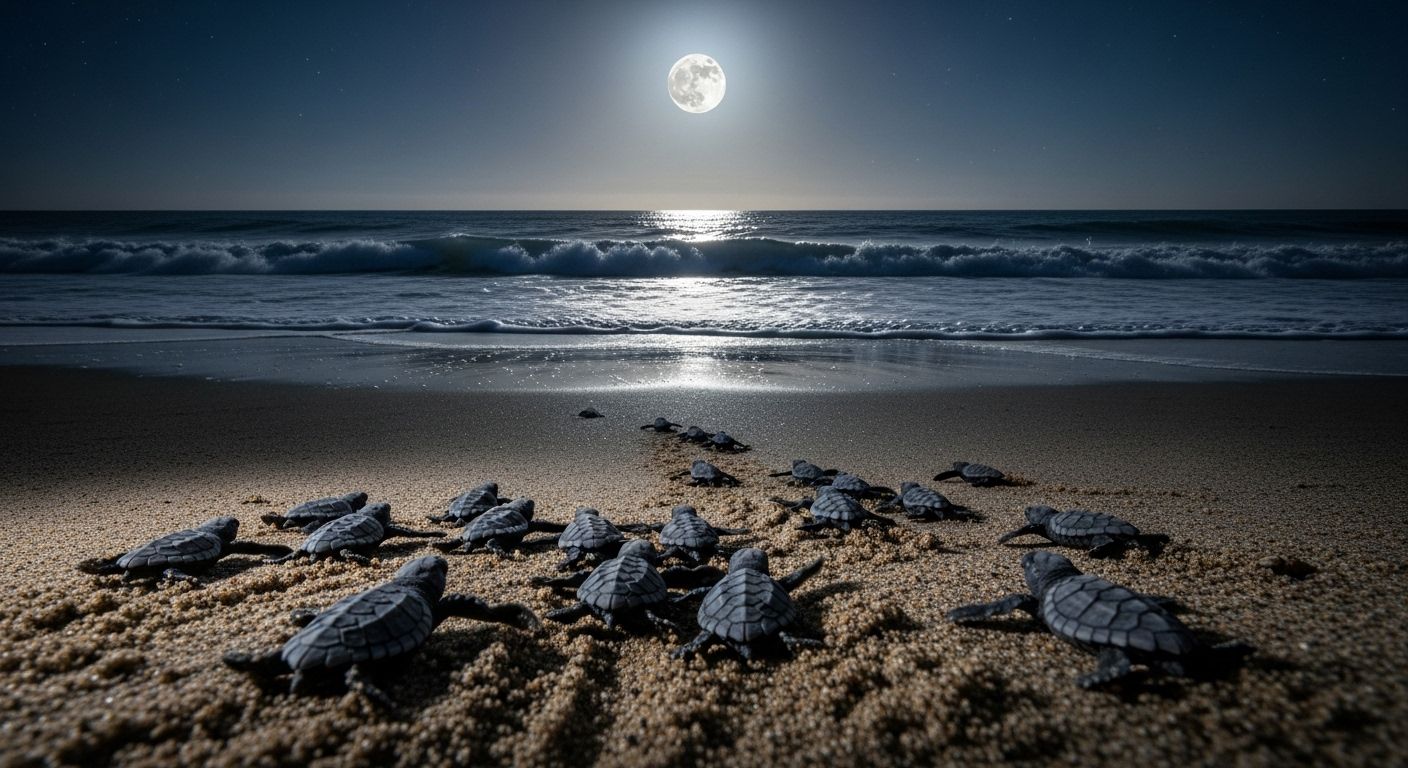
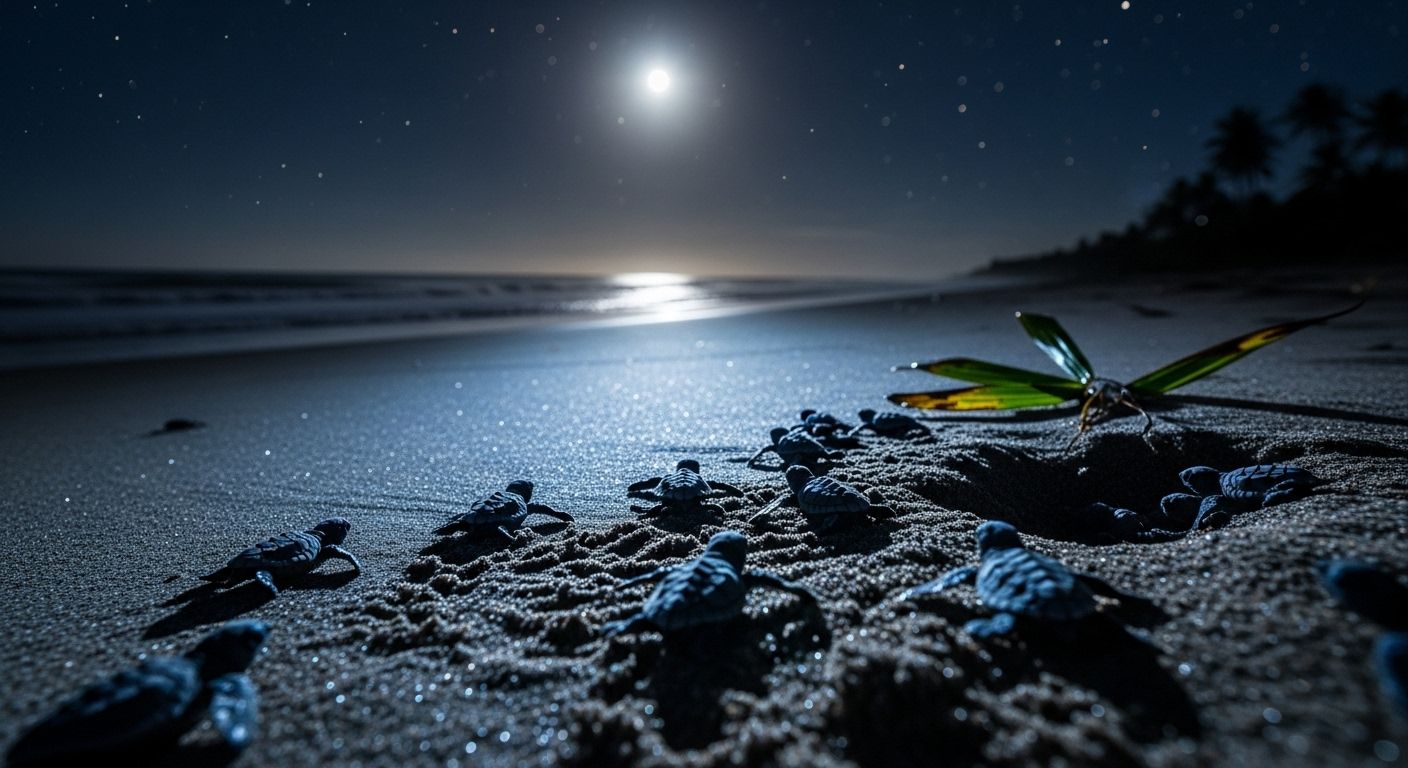
Hatchlings aren’t just cute—they’re tactical. Emerging under moonlight isn’t poetic fluff; it’s survival strategy. Fewer birds, cooler sand, less chance o’ gettin’ fried before reachin’ the tide. That’s why sea turtle eggs hatchings almost always happen after sunset. Volunteers patrol beaches with red-filtered flashlights (white light disorients ‘em) and hearts full o’ hope. Some nests even “bubble” first—tiny sand shifts as the hatchlings wriggle upward together. It’s like nature’s version o’ a team huddle before the big game: the race to the ocean. And remember, every successful crawl counts toward the survival odds—less than 1 in 1,000 make it to adulthood. So yeah, those sea turtle eggs hatchings are low-key epic.
Nest to Ocean: The First 30 Minutes That Define a Lifetime
Once the first hatchling breaks through, the rest follow in a wriggly, determined flood. They dig upward as a group—instinct synced like a well-rehearsed choir. Then comes the dash: flippers paddlin’ sand, eyes locked on the brightest horizon (which should be the ocean, not a condo’s neon sign—hence why coastal lighting ordinances exist). This crawl isn’t just adorable; it’s physiologically vital. Blood circulates, lungs adjust, and their internal GPS boots up. Interfere, and you mess with evolution’s fine-tuned script. The whole spectacle—from pipping to paddle—is the grand finale o’ sea turtle eggs hatchings. And if you’re lucky enough to witness it? You’ll never hear the ocean the same way again.
Temperature’s Secret Role in Sea Turtle Eggs Hatchings
Here’s a wild twist: the sand’s temp during sea turtle eggs hatchings doesn’t just speed things up—it picks genders. Below 83°F (28°C)? Mostly males. Above 88°F (31°C)? Mostly females. Right in the middle? A mix. Scientists call this Temperature-Dependent Sex Determination (TSD). But with beaches heatin’ up, some rookeries now produce 90% females. Not great for long-term genetic diversity. So while we ooh and ahh over sea turtle eggs hatchings, we’re also watchin’ a climate warning unfold in real time—tiny, vulnerable, and urgent.
Common Myths About Sea Turtle Eggs Hatchings—Busted
Let’s clear the air, ‘cause misinformation spreads faster than sunscreen on a windy beach. Myth #1: “You can help hatchlings by carrying them to the water.” Nope—you strip ‘em o’ their natural orientation process. Myth #2: “All sea turtles hatch in summer.” False—leatherbacks in Trinidad nest year-round. Myth #3: “If you find eggs, take ‘em home to hatch.” Big no. Disturbing nests is illegal under the Endangered Species Act in the U.S., and even well-meanin’ folks often kill the embryos by messin’ with humidity or rotation. Real support? Report nests to local conservancies and keep your dog on a leash. Knowledge is the real tide that lifts all sea turtle eggs hatchings.
How Conservationists Protect Sea Turtle Eggs Hatchings
From Florida to Oman, teams work overnight to mark, monitor, and sometimes relocate nests threatened by erosion or foot traffic. They use mesh screens to block raccoons, data loggers to track temp, and GPS to map success rates. In some places, hatcheries mimic natural conditions when beachfront development leaves no safe spot. These aren’t zoos—they’re emergency nurseries for sea turtle eggs hatchings that might otherwise vanish. And yes, it works: protected nests see 2–3x higher survival. So when you hear “hands-off,” remember—conservationists aren’t standin’ idle. They’re the quiet guardians o’ the dunes, makin’ sure each batch o’ sea turtle eggs hatchings gets a fighting chance.
What You Can Do (Without Steppin’ on a Single Egg)
Love sea turtles but live in Nebraska? No problem. First, reduce plastic—especially balloons and bags that mimic jellyfish. Second, support dark-sky initiatives near coasts (artificial light = death trap for hatchlings). Third, donate to legit orgs that fund nest patrols, not Instagram influencers with “rescued” turtles in bathtubs. And if you’re beachside during hatching season? Fill in holes, flatten sandcastles, and turn off porch lights. These tiny acts ripple into safer sea turtle eggs hatchings. Oh, and never buy souvenirs made from shells or eggs—it’s illegal and fuels black markets. Protect the process, not just the poster.
“The ocean doesn’t need more heroes. It needs fewer humans messin’ with its miracles.”
From Egg to Open Ocean: What Happens After the Dash?
Once those hatchlings hit the surf, they paddle like their lives depend on it—‘cause they do. For the next 24–36 hours, they swim nonstop into deeper water, enterin’ what scientists call the “lost years.” No one’s sure exactly where they go, though satellite tags suggest oceanic gyres and floating sargassum mats as nurseries. But that first swim? It’s fueled by the yolk sac they absorb just before hatching. Miss that window, and energy runs out. So the success o’ sea turtle eggs hatchings isn’t just about breakin’ shell—it’s about reachin’ that blue escape. If you’re still curious ‘bout their journey, swing by the Sea Turtle Farm homepage for updates. Or dive into our Biology section for science-backed deep dives. And for a step-by-step on their first hours, check out our guide Sea Turtle Eggs to Hatch: Begin Epic Journeys. Every hatchling’s story starts with silence, sand, and survival—and maybe a little help from folks like us.
Frequently Asked Questions
How long does it take for sea turtle eggs to hatch?
Sea turtle eggs typically take between 45 to 70 days to hatch, depending on the species and incubation temperature. Warmer sand speeds up development but can skew sex ratios toward females. This natural timeline is a crucial part of healthy sea turtle eggs hatchings and ensures hatchlings emerge under optimal conditions.
Why can't we touch baby sea turtles?
Touching baby sea turtles can interfere with their natural imprinting process, transfer harmful oils from human skin, and leave scents that attract predators. It also disrupts the critical muscle development they gain during their crawl to the ocean. For safe and successful sea turtle eggs hatchings, observation without interference is key.
What month do baby turtles hatch?
Baby sea turtles typically hatch from May through October in the Northern Hemisphere, with peak activity in July and August. However, timing varies by species and location—leatherbacks in the Caribbean may hatch into December. These seasonal rhythms are vital to the success of sea turtle eggs hatchings and local conservation efforts.
How do you hatch sea turtle eggs?
In the wild, sea turtle eggs hatch naturally when embryos are fully developed—no human intervention needed. Attempting to artificially hatch or relocate eggs without permits often harms them. Authorized conservation programs may use protected hatcheries under strict protocols to support sea turtle eggs hatchings, but private hatching is illegal and ecologically risky.
References
- https://www.seaturtle.org/nesting/
- https://oceanservice.noaa.gov/facts/seaturtlehatch.html
- https://www.worldwildlife.org/species/sea-turtle
- https://www.fisheries.noaa.gov/species/sea-turtle